Act V: The Future?
Playa Names
If you’re reading this, and Burning Man still exists, and you’ve never been, my advice: go to Burning Man. You don’t need to be a lover of vices to have a transformational experience. It is like a religious experience and for many, including myself, a ritual; a liturgy of the spiritual but not religious, the odd but apt nonreligious religious “affiliation.” Burning Man has many distinctive cultural elements. One of the most significant traditions of Burning Man is the “playa name.”
By the parlance of Burning Man, one who goes to Burning Man is a “burner.” Burning Man itself is the “real world,” while what we return to at the end of our ritual is the “default world.” “Radical self-expression” is one of the ten principles of Burning Man, and it’s not unusual to morph between identities on “the playa,” which is what burners call the portion of the Black Rock Desert where the burn is held.33 In line with unique identity or identities one might have at Burning Man, most burners end up with a “playa name” that they will often choose to go by at the burn.
Like most everything at Burning Man, besides a minimal standard of safety and robust mandate of consent, the rules are flexible. Generally, one receives a playa name from someone else. One might choose their own, though generally the convention is to receive it serendipitously. A playa name could come from a campmate or a total stranger, or even a divine transmission. My first playa name, which I now believe to be my true playa name and will use in the future, embarrassed me at first.
Matt Grigsby is my great friend who first took me to the burn. It was at the burn where, one day, he told me that he knew playa name, and that it was “the prophet.” This rightfully disturbed me. The reference made me think of Islam, and I had no desire to offend the sensibilities of anyone, especially with a name I was given. It was almost as if I were a child whose parents had named me a slur. I used it haphazardly that year, but never really owned it. By the next year I had restyled as “Sun Bunny,” which worked well for some time, as I would always always wear gold and bunny ears, if little else, on the Playa. I had nearly forgotten about that first playa name until a conversation just a few weeks ago with Raisa Tolchinsky, our beloved writing guru at Harvard’s Religion and Public, and Dean Holland.
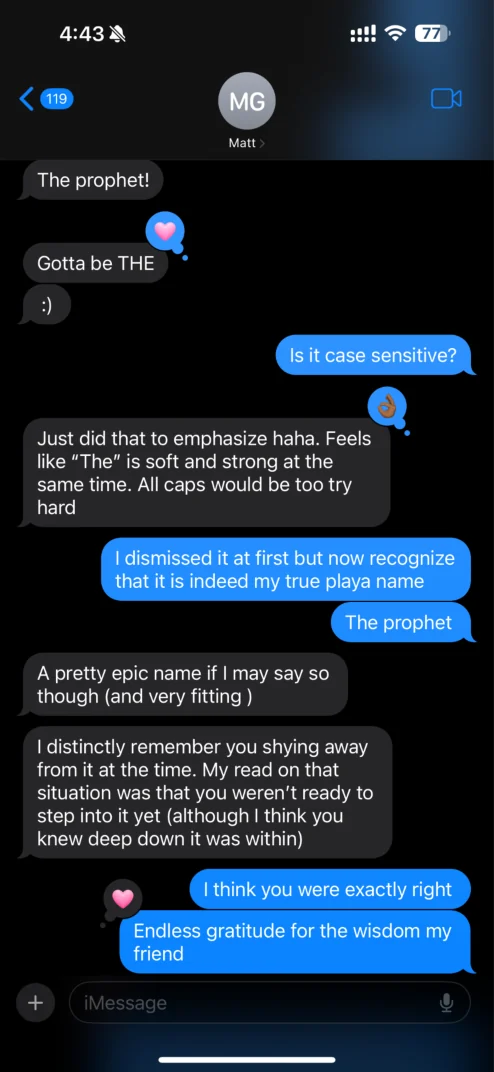
I was speaking to them of my lifelong struggle with seeing what others often miss. For a time I thought I was crazy. It’s only recently that I have come to realize that I am not. I cannot be sure of anything, and certainly not sure that I’m right, but I’m confident that I am more likely to be right than most of today’s pundits, especially on the matter of the vital intersection of technology and religion. Our economy will be no longer and our spiritual lives, which for many are completely undeveloped, will be the new essence of being. That is why I went to Harvard Divinity School. I was speaking of this to Raisa and Dean Holland, and that is when Raisa mentioned that I consider the story of Cassandra. At first I almost dismissed the suggestion. I think I said, “I don’t have prophesies.” But then I remembered that playa name, and realized it had some truth. I still don’t think I have prophesies, but I do think it’s important for others to see what I see.