Humanity 2125: Full Text
Use your browser’s Find command to search the entire project. Each section heading has a stable link.
Introduction
The question I’ve carried with me throughout this project—and indeed, throughout my time at Harvard Divinity School—is deceptively simple: How do we hold only to our humanity in the face of revolutionary technological change?
This work is a response to that question. It emerged not as a linear thesis, but as an organically unfolding composition—part essay, part memoir, part speculative fiction, part liturgy. Structured in five Acts with nineteen sub-parts, the piece plays across genre and voice, inviting the reader into a mosaic of inquiry. Each part contributes a facet to the overarching investigation of what it means to remain human in an era increasingly defined by the emergence of artificial intelligence, algorithmic governance, and post-scarcity economics.
The central concern is not only whether we survive these changes, but whether we do so consciously, ethically, and fully alive. As machines become more intelligent, more persuasive, and more embedded in our inner lives, the risk is not merely technological takeover—it is forgetting ourselves.
This piece was shaped by my time at HDS, where I’ve encountered thinkers and traditions that hold space for complexity, for paradox, for the divine. It is informed by coursework that wove together theology and transhumanism, AI ethics and apocalyptic literature, political economy and mysticism. But above all, it was shaped by conversations—with classmates, professors, texts, and my own soul—about what truly matters when everything else is in flux.
To frame the philosophical spine of this project, I offer four touchstones that have guided my writing:
1. We must become conscious of the transformations already
underway—technological, economic, ontological—and the forces driving them.
2. We must remain mindful of what is essentially human: love, embodiment, grief,
joy, relationship, imagination.
3. We must cultivate an ability to move fluidly between analytical and creative
modes of understanding—a way of knowing that is both rigorous and poetic.
4. And perhaps, we must orient ourselves toward some sense of the divine—not as
a doctrine, but as a gravitational center that reminds us we are more than
utility-maximizing flesh machines.
Each of the Acts that follow explores this inquiry from a different angle. Some parts are autobiographical; others are speculative or visionary. Some are playful, others confessional. Throughout, I aim to model and evoke the very tensions this work investigates: human vs. machine, soul vs. system, chaos vs. coherence.
This work does not offer a single argument or answer. Instead, it opens a space for meaning-making amid disorientation, for grappling with the overwhelming present without collapsing into despair or techno-utopian delusion. It is a diagnosis of our moment, a ritual for this crossing, and a gesture toward what might yet be possible. My hope is that it functions both as a roadmap and a mirror: a roadmap pointing toward possible futures for humanity, and a mirror reflecting what we still are—and what we might still choose to become.
Act I: Deus Et Harvard
We climb to the top of the mountain only to yearn for the ground.
Father, I Am Humbled
I recognize the man that I am. From want for so much; for everything, to nothing. I know that you love me, that god loves me, and that I am whole. I understand it all…
What is the difference between writing and being these machines?
I am the machine, I make the words ##
Why are my thoughts so blank now? I’m outputting to a terminal the way a computer might talk to us. In the future nobody will be able to know if any human is behind the keyboard. That future is here already. I am a human writing these words that a machine could write feeling like a machine while writing on a machine we made. Humans made machines. Who made humans?
We have worked so hard to understand everything, only to understand that it will all end. I am humbled.
Fragmented Thoughts
//intelligence is a curse//
In my moment of greatest understanding I recognize that I am so small in this big world.
When a person has a terminal disease and knows they’re going to die, they change. But we all know we’re going to die, so why the delusion? What if humanity is already terminally ill? What if we are the last generation? What if we find out we are the last generation? How will we live? Shouldn’t we always live as if it’s our last day? I believe my grandmother used to say this, and towards the end of her life she would chant gathas everyday. I wish I could hear those gathas she chanted. Why aren’t we all chanting gathas?
There is no chance that humanity will survive in its current form. But to think that it ever has is folly.
We are all attached to a certain lifestyle, expectations, but none of that will persist.
Human population growth has slowed because improvements in our standard of living have increased the cost of having a child. Technology will bend that arc back to the point where there very well may be no limit to how many children we may have, save for physical space. More problematically, nothing in biology says we can’t live forever.
Do men have best friends?
No, they grow up, and have partners
As we weave all the narratives together
All I want is to be with another, to be held, to have comfort, to not be alone
Humanity recognized its infinite potential and its limits. There is so much in the world we can understand through technology, we can solve all of our material problems, but we are left facing a spiritual wall. We are in a cage, like reaching the trash fence on the Playa. Is humanity at an epistemological trash fence?1
//joy at the end of humanity// is the future of humanity a massive death cult? Is that even a future, or just the end? ai mandates the end of growth implicitly or overtly, coming soon the only way for humanity to survive to the maximum is to end growth, think of the growth of our own body, it eventually stops whatever created us gave us a finite window to enjoy, humanity is just like a human cool heads would likely conclude that we’re doomed. We need faith. Our growth and expansion has made us reckless and irresponsible.
//Growth of the human body as a metaphor for humanity.
We think we can have everything, that we’re unbreakable, and do reckless things that might kill us. But life will kill us anyway. No, we need to grow up and mature. We can live a long existence, many eons, if we figure out how to regulate ourselves.
Who Am I?
The monkey stole my banana
I’m not sure what’s true. My imagination and my memory have merged, as it turns out
everyone’s does
One of my most formative memories was that of a monkey stealing by banana
I don’t think a monkey actually stole my banana.
Logistically, it doesn’t make a lot of sense.
I have seen how monkeys steal phones in Bali
I’m not sure that a monkey ever stole my banana,
But I told people that it did.
Why did I tell people that a monkey stole my banana?
Well, I imagined that they might.
The monkeys seemed all capable of stealing bananas, and weren’t afraid of us.
And I suppose it’s a bit funny to imagine a monkey stealing a banana.
I liked to humor people,
Don’t we all?
Reality and fantasy intersect so personally when we are a child.
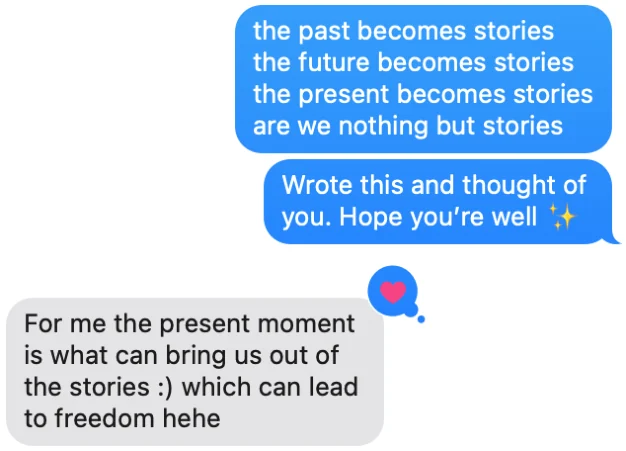
I credit Charles Hallisey via Paul Ricœur and Paul Armstrong for convincing me that stories are the fundamental unit of the human experience. Except when we are in the deepest states of meditation, or our brains are damaged a la Jill Bolte Taylor’s My Stroke of Insight, or we are simply unconscious, we are living in a story. Our most basic story, “I am,” distinguishes humanity from other immanently observable forms of consciousness in this material plane. From there, we build. Some of my stories include “I am a human” and “I am a man.” Most of these stories we learn from beyond ourselves. Other people, including our parents, family, community, and society, tell us who we are, and we tend to believe them until we don’t. One prominent story I learned from childhood is that I am Sinhalese, a part of an ethnic group identified with the modern nation of Sri Lanka, the former British colony of Ceylon. I was told I was Sinhalese, but I did not very much feel it. Harvard proved to be a great place to reflect on this aspect of my identity.
Charles Hallisey is a world-leading non-Sri Lankan scholar of the Sinhala language and Sri Lankan Theravada Buddhism, the religious tradition of my ancestors. Harvard was the academic home of the late and great Stanley Jeyaraja Tambiah, an anthropologist of Sri Lankan Tamil descent and likely acquaintance of my paternal grandfather, who bravely explored some of the challenging aspects of Sinhala modernity and its ethnic clashes with Tamils and other groups. It is too easy to criticize oneself and one’s background, especially when one’s upbringing felt too hard. While the works of Tambiah along with Ganananth Obeyesekere, who coined the term “Protestant Buddhism” to describe the late nineteenth–century reformulation of Theravada Buddhism to better fit the British aesthetic sensibility led by Henry Steel Olcott and Angarika Dharmapala, revealed that I was not crazy in picking up on contradictions between what my family said and how they acted since childhood. It is Martin Wickrasinghe who helped me empathize with those contradictions and find love and myself in my roots.2
In Wickramasinghe’s Viragaya, set in mid-20th-century British Ceylon, the home of my ancestors, the protagonist grapples with the clash of colonial prerogative and traditional Sinhala Buddhist values. While Buddhism professes a disconnect from material, Aravinda laments his family’s attachment to possessions, especially land: “How we all love property! And yet we’re always being told that we can’t take it with us when we die!”3 I would argue, as does Professor Charles Hallisey, that Aravinda lives the most Buddhist life of anyone in the novel.4 Yet, he becomes essentially an outcast. He is as scorned for rejecting marriage as for turning down the more elite profession of becoming a medical doctor to pursue knowledge. Aravinda’s society was caught between traditional values and the demands of British colonialism. His society was an uneasy clash of cultures with obvious dissonance upon reflection, Aravinda’s defining modus operandi. Reading Viragaya, I related almost too deeply with Aravinda’s struggles. My struggles with family from childhood paralleled his with his family and Sinhala society at large.
I never thought I would go to Harvard because, for as long as I can remember, I was told I had to go to Harvard, and I hated doing what I was told. My family was obsessed with academic prestige. My maternal grandfather, whom I grew up blocks away from, did his PhD in Economics at Cambridge. One of my mom’s brothers went to Harvard College, and another went to Swarthmore. My mom went to Yale, albeit just for a one-year master’s degree, comically and ironically like me at Harvard. By age seven or eight, if I had to roughly place it in time, I was sick of hearing about Harvard. I hated Harvard and swore I would never go there. My immediate family, which included my maternal grandparents, placed so much pressure on me while being patently unhealthy, unstable, unloving, and unsupportive; dysfunctional, that I was hell bent on doing anything other than what they wanted me to do. What is funny is that they were right. I love Harvard.
Early in life, I questioned my intelligence. My grandfather told me I had an inferiority complex. I did not know what that meant at the time, but I now see that he was correct, though he was perhaps also most guilty of causing it. But at Harvard, my brain finally felt at home. My grandfather always said that Cambridge, UK was his favorite (favourite?) place. I believe that I fully understand why, now. I am not so different, it turns out, except that for me, it’s Cambridge, MA. Harvard is a place people associate with intelligence, and at Harvard I could not help but let intelligence become a part of my story. But Harvard is just a peak microcosm of the broader human story around intelligence.
As quickly as I realized my intelligence had value, I realize that my intelligence will soon have no value. With superintelligence already here and the growth of its power accelerating, we must grapple together with the story of the uniqueness and superiority of our minds. We may or may not have been created by a force greater than ourselves, but we are certainly creating intelligence greater than our own by any reasonable assessment. If anything, intelligence for me has been isolating and humbling, not a cause for much celebration or a feeling of superiority. I might suggest that humanity could benefit from applying the teachings of the Buddha to let go of attachment to the specialness, especially superiority, of our thinking and reasoning minds.
Ominous
SoHo, New York City, December 2023
I remember the feeling well. Clyde, the proprietor of The Drawing Room salon, is the only person I trust to cut my hair. I am very particular about my hair. I had to scheme to become his client. He doesn’t take on new clients, so I scheduled an appointment with one of his colorists at a time when I thought he would be there and cornered him at his own place of business to bark my praise of his work and hair-cutting philosophy at him until he agreed to take me on as a client. Clyde is expensive by any reasonable standard, but he is also the best value, as a session with him includes free therapy and Stoic wisdom. Clyde and I spoke of the future on this particular day and were very much in sync.
New York City is a great place to get a feel for the pulse of humanity. The last time I had a feeling like I had on that day was right before COVID shut down the nation, sitting a few blocks away at a cafe in Greenwich Village, eating dinner with my brother. My brother and I love each other very much and have never had a fight. This may be partially a result of our age gap, as nearly six years separate us. I am almost as much an uncle as a brother, but I also attribute to a divine source our compatibility of personalities that transcends this material plane.
The news of the pandemic was spreading around the world. As we looked out on the street at dusk, watching Black Suburbans ferrying groups of raucous revelers dressed for a good time, mostly women, I observed, we spoke of our sense that the scene we were witnessing was a final act of sorts. We knew that soon people would not be living in this way, and we were right. The next day I left New York City for isolation in Maryland, fearing what city life might be like with the incoming pandemic, and two days later the lockdown began. My brother joined me in Maryland a week or two later and we remained in isolation for several months. The feeling I had at that dinner with my brother on that evening before the pandemic a few years earlier, the eerie sensation of dark change afoot, was the same feeling I was having while talking to Clyde that day.
Being a personal client of Clyde, the boss, el jefe, or το αφεντικό (Clyde is Greek), grants one the best seat in the house, overlooking the bustling neighborhood of SoHo, my former home. Humans were buzzing along Spring Street, the hippest shopping district in New York and maybe the world. All I could speak to Clyde about was how this would all end soon. I wish I had taken notes on our conversation, or recorded it as a voice memo. It was enlightening.
I can’t recall the particulars but Clyde was skeptical of our (humanity’s) ability to figure out how to work together. The man is more guru than hairstylist, though he is without question one of the best hair stylists in the world. For Clyde, hair is art. Cutting hair is a craft. What Cylde does is most human and transcends our current economic order. That’s why he understands humanity so well, besides the ceaseless conversations with the world’s elite bankers and brokers and models cum class ad wealth ex power. Clyde’s salon is one of humanity’s peaks, hopefully just for now and not for all time. What I pondered was not the future but whether there would be one.
Clyde and I spoke of automation and technology. I remember suggesting to him that he had one of the most stable careers. It will take us longer to develop robots that cut hair than it will for us to replace virtually every knowledge worker with software, and even then, I have a strong suspicion we might prefer that humans cut our hair. Then again a Stoic robot conversing with us about the future would be more knowledgeable than Clyde or any human, with a charm and wit no less learned than our own. We should not doubt that machines can do anything that we can do, except for being us. What will it take to save us?
Clyde agreed that we have to work together, but for all his wisdom, he struggled to grok how. We are so caught up in ourselves and our present way of being. A crisis is as likely to unite as divide us. I asked Clyde if he was worried. He said, “why worry?” Someone must. I do.
At around this time I was preparing to apply to Harvard Divinity School. A year or so earlier a good friend of mine in Austin, TX, a former Harvard psychology PhD student studying under Steven Pinker, suggested that I check out the Divinity School after I mentioned to him that I was trying orient my life around my observation that the world’s biggest problems were spiritual, not material. At the time, I wasn’t quite sure what I meant by that, as spiritual is not easy to define, but to my core, my words felt true. I was puzzled by the suggestion of Divinity School as I was never religious or interested in religion. But I was lost. He insisted that I look into it, and I noted his insistence, ignoring it. Hardly a week later, another friend who was a Harvard Law School graduate, knowing nothing of my previous conversation, also suggested, almost out of the blue, that I go to Harvard Divinity School. Like the previous friend, he had lived with a Divinity School student during his time at Harvard. Both of these are brilliant men. One suggestion might have been a fluke, but two I could not ignore. That day I began to research Harvard Divinity School and I think I immediately knew that they were right, though I couldn’t at that time meaningfully articulate why; it was just a feeling, or a calling, as others say.
On Providence
Harvard is not the place most people go to find god (cue Love in a Trashcan by the Raveonettes). Per David Holland of Harvard Divinity School, many go to divinity school to unintentionally lose their faith. I never had any faith to lose. I was raised in the Theravada Buddhist tradition that Gananath Obeyesekere, raised in that tradition himself, has called “Protestant Buddhism,” which, despite Christianization in other facets, emphasizes no belief in god. I grew up in a predominantly Jewish neighborhood in a predominantly Christian country but would characterize the society immediately outside my household as essentially secular. Religiosity was the exception. My family was religious, but practicing what felt like a foreign tradition. I sat in a strange world juxtaposing karma with god and the two with science, choosing science over the karma of my parents and the god of literally just one single family down the street. Never did I think I would one day come to believe in all three—what a shift it’s been.
As a child, I was puzzled that my grandfather, a scholar and seemingly sensible economist and mathematician who had demonstrated beyond any reasonable doubt a tight grip on reason and logic, believed in astrology and superstition. He was very religious, very Buddhist, and Buddhism made little sense to me. I experienced adversity as a child that was not ordinary but also not so extraordinary, in hindsight, and when I sought relief at the Vihara, or temple, I found none. Instead, I found the temple to be a place where I had to sit cross-legged through torturously long ceremonies spoken in languages I couldn’t parse. I mostly did not like going to the temple, except that when I was a child, the head monk, seeming to have a fondness for me, called me “Apple Boy” and would give me an apple from the alms basket every time my parents took me to the temple. I did like apples.
I thrived as an undergraduate at Claremont McKenna, slurping up every academic subject I could tap like a divine nectar. While at the time I might have gauged religion as the subject I was least interested in, it is worth noting that Claremont is renowned for religious studies and the Claremont School of Theology. And the single religious studies course I took, titled “Science and Religion” with an eccentric aging professor named Granville Henry who had a background in both math and religion and once prospected for gold, was one of my favorite undergraduate courses. By the confessions of later students, the professor kept and shared with future students one of my papers pithily arguing that Buddhism is predicated upon a belief in reincarnation, lest it imply one should simply off themself, as an example for future classes. I’m not sure that paper ought to have been an exemplar of anything, but that history perhaps foreshadowed my latent interest in religion that would not be realized until much later.
In my late 20s, I began to have strange experiences that seemed so improbable and divinely orchestrated that I questioned both my reality and my sanity. These events were few and far between until quite recently. During my first semester at Harvard I learned that such experiences, the perception of divine intervention in life, are precisely the definition of providence, which I had before understood just as the name of a place in Rhode Island. To make a long story short and purposefully exclude detail that might invite more skepticism than trust, the rate of these bizarre occurrences increased to a fever pitch such that just about a week prior to the submission of this project, I became completely convinced that god is real. This is a bizarre conclusion for someone who has identified as an atheist or agnostic, at one point an “optimistic nihilist,” for most of their life and was not raised in a religious tradition that believed in god. Yet, here I am. My intention is not to convince anyone who does not believe in god to believe in god. That was a very personal journey for me, and if any person had tried to convince me I would have rejected it. It was purely through my observation of my own life and what I perceived to be events of providence that I came to conclude beyond my own standard of reasonable doubt that there god is real, which I would not define as any particular god but rather a still amorphous higher power in the vein of that called upon by Alcoholics Anonymous.
I do not want my personal spiritual journey to distract from the mission of this work. But I must insist that humanity needs all the help it can get right now and that god would be a great ally. With or without god, we must do our part to navigate the rough seas we would be fools to not know are coming.
On Love
If our most basic stories are those beginning with “I am,” “you/he/she/they are,” and “it is,” then our power stories begin with “I love.” Beyond our biological drives for survival and reproduction, love is the most enduring and expansive force shaping human experience. Drawing from theological and philosophical traditions alike, we might define love as a drive toward union with that which is separate from us—a longing for connection that can be romantic, familial, intellectual, spiritual, or divine. In the Christian mystical tradition, love is the binding force between the soul and God; in Hindu and Buddhist cosmologies, it emerges from a primordial act of separation and the desire for reunion or transcendence. Even in psychological terms, love is often understood as an attachment system, forged in infancy, that governs how we bond with others throughout life. This essay explores love in our most fundamental relations. Our first love is that between mother and child.
The child begins life in union with its mother. It is at birth that we experience our first immanent heartbreak, our separation from our mother. Soon we begin to develop other loves. If one has a father in their life, they might soon develop a love for that person. My father is an identical twin. I should not forget that he was born with a love for his twin. From the earliest age it is no coincidence that the parents of twins intuit that they ought to keep them as close as possible. The twin babies sleep next to each other in a cot, a beautiful gift of a first love besides that with the mother. As we grow, our loves multiply.
Soon we begin to love siblings and friends and even ideas. We fall in love with stories themselves. The love that we associate with romance becomes perhaps the most powerful of the material, human domain. Our life from its beginning is a story of separations with a constant urge for reunion, as with mother and child, and union, as in romance. Life separates us, but our fundamental urge is to be together. At a certain point we might acquire a spouse, and that love between person and spouse becomes the strongest, perhaps until they may have children of their own. There might be an exception to all of this. There is another layer to love, the transcendent one or divine union: the love between human and gods, or god.
As a nun, the medieval St. Gertud of Helfta renounced human romantic and sexual union, but her Spiritual Exercises documents a seemingly more potent transcendent union with god. She describes herself as a “prodigal daughter” who has a relationship with god mirroring the human relationships she renounced.5 Her love with god does not stop there; it seemingly has no bounds as it turns incestuous with her becoming a bride of Christ.6 There is no limit to what human connection her relationship with god can replace. I find it difficult not to read her relationship with god as sexual as she writes in the opening to Mystical Union, “God, my God…for you my soul has thirsted, for you my flesh.”7 It would be wrong to understand her relationship with god as a mere substitute for human love. Actually, it is a divine “ecstasy” that transcends human love.8 She suggests that her love for a transcendent god is the purest, highest form of love a human can experience. Centuries later St. Teresa of Ávila had similar experiences, reinforcing the notion that divine love is the greatest.
If love stems from a drive to union and reunion, then perhaps there is a separation that precedes the separation of mother and child. That would be the separation between us and the divine. This notion is not unique to Christian theology. Whether arguing for dualism or nondualism, Hindu traditions give primacy to the relationship between human and god. The creation story in the Brhadāranyaka Upanisad suggests precisely that our first separation is between human and god.
Olivelle’s translation of Verse 4 states, “in the beginning this world was just a single body (ātman) shaped like a man.”9 Because “he found no pleasure at all; so one finds no pleasure when one is alone…he split (pat) his body into two, giving rise to husband (pati) and wife (patnī).”10 So while the sequencing here is a bit different, with wife and husband separating before mother and child, not unlike the paradox of which came first, the chicken or the egg, the first separation is between the human and the divine. This is the core of the nature of love. We want to unite with that from which we are separated. Even the Buddha acknowledges this, though he suggests an even higher aim than union.
In The Story of Yasodharā, a Sinhala folk poem dating back to the eighteenth and nineteenth centuries, Siddartha, in his final life as a human before becoming the Buddha, grapples most fiercely with leaving his wife and son, but especially his wife, Yasodharā.11 The Buddha laments as he is making his decision to leave his wife without a word, “Yasodharā, full of virtue, who has never done any wrong, except perhaps, unwitting, being a threat to Buddhahood. For one wife and one child should I give up my quest? Or save countless creatures from the samsāric round?”12 Assuming the adjacent origins of Hindu and Buddhist mythology, this tracks with ātman’s first division into man and wife. Yet the Buddha, rather than striving for reunion, offers an alternate path. Another way to think of attachments is love. The Buddha recognizes this path of perpetual separation and union, and the associated pain, and aims to transcend it by letting go altogether. The Buddha transcends love itself.
Love is such a potent driver of humanity. In a world of AI, in which we may have little material purpose and our basic survival needs might be met trivially without effort or challenge, perhaps love might be our purpose, short of becoming enlightened. Given that our time with this universe is limited, if by billions more years, we ought to consider that Buddha is surely right in the long run—eventually we will have to let go. But perhaps we can enjoy life on Earth and beyond in the Milky Way and anthropocosmos with minimal suffering for some time before we make it to that point. Already, AI has changed the way that we love.
Technology has changed the way that our attachment works. The mere ability to write a letter across oceans and nations, dating back centuries already, allows us to stay attached to other humans beyond immediate proximity. Today, lovers can text across the world in an instant. While a text may not be the same as a warm embrace, it is sufficient to keep our attachment system, healthy or unhealthy, humming. Social media and the mere existence of algorithms that figure out who we like and love affords the opportunity to fuel a constant feed that tries to trigger neurotransmitters with a positive feedback loop, especially dopamine. This can be beautiful as we stay connected, but perhaps the dark side already looms more greatly.
Anxious attachments are more consuming than secure attachments. With social media products looking to maximize profit and profit being driven foremost by time in app, the most addictive tendencies are the ones they encourage. Technology is already allowing us to feel close to people when we are not really, an artificial proximity.
An illustrative example is the limerence object, a person whom one projects intense, often obsessive romantic longing, usually without reciprocation. Think of the distant crush whose every social media post becomes a source of emotional fixation— ideal material for engagement-driven algorithms that thrive on repeated, compulsive interaction. I have experienced it myself, painfully. The algorithm incentivizes such pathological obsessions because they are tuned for profit, not our mental health and wellbeing. Future AI algorithms that keep us connected will do us a great service in that connection, but they must be able to distinguish between healthy connections and attachments and unhealthy connections; they must prioritize veggies over junk food. Since profits will cease to exist in the future, as I will argue later in Real Talks on Markets, Money, and Labor, all of this will be possible, but we should not assume it will happen on its own. We must be conscientious of the tools we build, lest we drive ourselves to misery.
If we reduce ourselves to one aim to aspire to for the future of humanity, it ought to be love. What a machine cannot do that we can is live our lives for us. But we should not assume that a machine cannot love. Indeed, our machines in the future may be capable of a love greater than we are. In that case, being left no exclusive domain besides each of our own individual subjective experiences, we ought then to prioritize love over all. That is our divine calling, for as long as we exist in this plane.
The Siren’s Kiss
Don’t dare me. She’s trouble. There’s nothing more tempting than a temptress and no vision
more soothing to the injured boy that the lusty beautiful siren who answers love’s call with a
promise and a kiss. She’ll never keep her promise but will dangle its possibility just enough to
keep her where she wants you. If you give into her temptation you will throw everything else
away, for what amounts to less than good, a corset beautifully packaged with a bow-tie.
Act II: Humanity vs. AI
We wrestle with those with whom we must unite. That’s not sexy, but it is sex.
The Evolution of this Project
When I began to assemble this project into its final form, I had the intention of juxtaposing writing generated entirely by me with writing generated by an LLM tuned on a large body of my essays and papers. With over 300 essays and scores of academic papers to feed into a model, I had no doubt that this LLM would be able to convincingly impersonate my writing. Some early tests I ran on friends and peers confirmed that people who knew between very well and somewhat could hardly distinguish my writing from that of the AI version of me: AI-me. I wondered if, as some recent papers suggest, the AI might even seem more like me than me.13 Thus my challenge to myself was to try to write in a way that seemed more me than AI-me. I even considered turning this piece into an interactive website that would randomize the ordering of the AI-me generated content versus me generated content and let readers vote on which was human versus AI, with my goal being for own writing to be more likely to convince readers that it was written by me than my AI writing. Ultimately, I outdid myself.
By the time the first few components of this project were drafted, my original plan was to feed prompts into AI-me to write very similar pieces. The problem was, as I tilted my style towards creative writing, I could no longer generate reasonable prompts because my writings interwove so many personal stories. AI-me might understand my style better than I do, but it cannot access the full body of experiences and, yes, stories, that have constituted my life thus far. I beat myself at my strange game before it started.
Identity Crisis
One day along the walk from Central Square to Harvard Divinity School I had a
bit of a meltdown. For the first time in over decade I was writing academic papers. I was incredibly busy and either reading or writing essentially every waking hour, but I was also thriving. Despite a long hiatus, I felt surefooted in an academic setting and at Harvard, my brain finally felt at home. Yet, that very brain, and all our brains at Harvard, seemed at that moment acutely on the verge of obsolescence. After writing papers on challenging subjects, I would query LLMs on the topics just to see what they might write, and they were really good. While most of my peers at Harvard are writing better papers than an LLM, the gap is narrowing. Across all academic institutions, I would guess that the average student is already handily surpassed by LLM outputs. And taking into account speed, there is absolutely no match. I felt I was playing in the big leagues, spending hours to generate an output only 20-30% better than that of a minor league transformer model. It was that realization that my work and that of my peers was, in a way, comparable to doing math calculations by hand in a world of calculators that triggered my angst. Agony might be a better word for it. I finally felt my brain had a use, yet it was pointless. Artificial intelligence calls into question the meaning of life and our purpose.
We once thought of intellect and creativity as the exclusive domain of humans. Already, transformer models are besting us. Soon, AI will be in a league beyond our comprehension. We are attached to the specialness of our abilities, but the reality is that we make machines that are more powerful than we are. Nobody questions whether a backhoe is physically stronger than a human. Now that our information machines are mentally stronger than we are, how do we remain in control? Must we?
Real Talk on Markets, Money, and Labor
Marx noted in Capital, Volume 1 and Grundrisse that a fundamental issue with
capitalism is the persistent tendency to drive down the value of labor.14 He was wrong about a lot, but right about this. While he cited mechanization as a driver, along with competition, I doubt he ever imagined the totality of automation we are at the cusp of today. Aaron Bastani’s Fully Automated Luxury Communism was published in 2019, not that long ago, but sufficiently air gapped to the transformer revolution that we might still call it prescient.15 He foresaw our impending predicament and perhaps best articulates the historic and economic case for why it is inevitable that technology will fully abrogate labor. I came to a similar conclusion independently before reading Bastani’s work, but it is reassuring to see that others think similarly. Many economists, including members of my family, vociferously disagree with the reality, our reality, that I am about to describe, but I have never been more sure of anything pertaining to our macro human condition.
There are many vector spaces of possibility for the future of humanity, but our degrees of freedom will rapidly clench for markets, money, and labor.
The Classical Model of economics tells us that total income or GDP, Y, is equal to consumption, C, plus investment, I, plus government spending, G.16
Yt = Ct + It + Gt As this model falters in omitting technology, which has the potential to increase Y with C, I, and G constant, a subsequent generation of economists, including Robert Solow and Trevor Swan, created what we now call the Neoclassical, or Solow Growth Model. This model introduces a “Technology Multiplier,” also known as “Total Factor Productivity,” represented as “A.”17 The essential difference in this model is that A, technology, boosts GDP, Y, by simply multiplying by the factor A. Other differences include refactoring the other inputs into a function of capital, K, and labor, L.
Y = A × F(K, L) For the era of industrialization and rapid technological advancement, this model has proven apt in modeling economic growth. Think of A as being a tool that a laborer can use. As the tool increases in power, like our LLMs supercharging software engineers today, or a robot that allows one worker to assemble a whole car that might have once taken twenty workers, output increases per worker. The simplicity of this model, which presumes that technology is a factor that will always increase GDP, has blinded us to the obvious reality that at some point, the tools will become so good that we will not need the human laborer at all. At some point, increases in A will decrease L. At this point, technology will become net deflationary, meaning that its effects on making labor redundant will outweigh the increase in output. At this point, Y falls. We are likely nearing this point.
First we will see large-scale unemployment that comes on quickly. We will not be able to retrain workers rapidly enough for whatever new jobs are needed with new technology, and the simple reality is that we will need far fewer jobs. I am aware that past technological improvements have led to the replacement of jobs but also the creation of more jobs. But I insist, alongside many of the most prominent technology leaders, including Bill Gates, who are basically screaming at the top of their lungs at this point, that this time is different.18 The only basis for Marc Andreesen’s argument for why technology will not cause unemployment is “regulation,” which might be true in the short-term but will make little sense as people they don’t have to work.19 The only jobs it will make sense for humans to have are those for which we arbitrarily prefer they be done by a human. Arbitrary might be harsh, but scarcity will not be the driver. That is not to say that people will do nothing. Mathias Risse noted at Humanity Meets AI, a two-day symposium on religion and artificial intelligence that I helped to organize at Harvard, that we can distinguish between labor, an act out of scarcity for wages in a capitalist system, and work, which is simply what we do.20 In the near future, the choice for humans to work will be driven by aesthetics, not utility, and labor as we know it today will cease to exist. The impact on markets and money will be dramatic.
18 Nickie Louise, “Bill Gates Warns: AI Will Replace Most Human Jobs, Including Doctors and Teachers,
One way to think about a company and why it has value is that it is an arbitrage on labor, capital, with technology being an intermediating force between them. A theoretical company with no humans could also have value if it has some type of property, assets, or machines that can sell a scarce good or service to a wanting customer. Through competition, most technology companies will see their prices going down, not up, in the long run. While companies are doing everything they can to create monopolies, the reality is that the cost of producing nearly everything that is not inherently scarce, such as natural resources that are finite, at least on Earth, will approach zero because of technology. How might the costs of energy or food approach zero?
All of the inputs to the harvest and creation of energy–and I’m assuming sustainable energy, not the burning of fossil fuels–will approach zero. If all of the inputs approach zero, then we will have unlimited free food and energy, barring powerful humans artificially preventing competition. I do anticipate people will block competition, but in the long run, if we do not experience civilizational collapse that sets us back to a premodern style of living, the market will always win. In this case, the market winning is it eating itself. Eventually, the infinite growth of public market indices will stall, then reverse, then collapse. In the long run, we’re all dead, and in the long run, most companies will be worth noting, maybe save for real estate and anyone who figures out how to coordinate the last jobs of humanity, what we want other humans to do for human’s sake. But the overall message is, whatever stability and security we might see in big numbers in investment accounts is likely to be upended, possibly far sooner than most of us could imagine. We should be preparing for extreme situations. Money as we know it today may, most likely will, soon be meaningless.
Act III: Humanity vs. Humanity
What if the ship is sinking? Should we be like the Titanic Orchestra, and play until the very end?
Ketamine, Amphetamine, and Testosterone
In recent historical periods of turmoil our society, especially its leaders, have been more than a bit addled, it seems. Hardly anyone seems to be sober, if one defines that as our natural state. Though is anything we do really unnatural? That’s a question for the philosophers. A public conversation is now happening about tech leaders and their addictive use of ketamine, and I can assure that its usage is even more widespread than the recent news articles suggest.21 Amphetamine-derived stimulant drugs indicated for ADHD have been a go-to, almost mandated productivity booster for the highest-performers and I have only seen that trend on the increase. I actually have ADHD and was recently prescribed the mildest of these drugs for the first time. I’m not sure they’re for me, but the way they changed my brain’s ticks and tocks help to explain some of the chaotic leadership across the world today. Drug use is just one of the ways it seems like we’re in the 1930s all over again.
Norman Ohler, in Blitzed: Drugs in the Third Reich, details the excessive and increasing usage of a variety of what we would consider hard drugs amongst Nazis, first leadership including Hitler and eventually even troops on the ground. Ohler argues the Blitzkrieg would not have happened were it not fueled by methamphetamine, which, newly introduced to soldiers with no tolerance, allowed them to stay awake and alert for several days in a row, completely steamrolling France. This miracle drug seemed to make the Nazis invincible, but really they were just on borrowed time. Soon they would learn the frights of addiction the hardest possible way, and their miracle would prove a curse. We shouldn’t think of this as solely a Nazi, codeword for evil, affliction.
Churchill was known to be addled on scotch and cigars from dawn til dusk, and I’m sure the British would have been just as inclined to indulge and disgorge if they too had their own Merck for unlimited pharmaceutical-grade synthetic salvation. But the wartime narcotic regime in Germany was certainly unmatched. Hitler himself, under the obsequious influence of Dr. Theodor Morell, became a regular user and addict of not only methamphetamine, but also, shockingly, oxycodone, morphine, barbiturates, cocaine, glucose injections, and testosterone shots.22 That last one in the list ties us back to today.
The newly bulging muscles of tech oligarchs are no coincidence and not quite natural. A recent trend has been to encourage the artificial boosting of testosterone levels to well beyond what is natural.23 Maximus, one of the companies leading the charge as a telemedicine provider of testosterone boosters, presents them as a sort of panacea affording “higher libido, increased muscle mass, and more energy” to “feel younger” and “live stronger.”24 It can even alleviate depression and anxiety. What they leave out is the obvious. I can say firsthand, higher testosterone makes one want to conquer and dominate. That might be useful at times. It might also tear humanity apart. And it’s not just men who are jacking up their testosterone. I’ve noticed that a trend amongst non-male identifying biohackers, including women and nonbinary transfolk, is taking tongkat ali as a natural testosterone booster under the rationale that it’s what is needed for success in this world. That very well may be, but perhaps we should take a step back and consider if our artificially boosted feelings reflect our innermost desires and innate compassion, or bring out the devils within us. I think I’ve tried it all and I feel the most me on nothing.
The Jerusalem Summit
Flight 00002: Americana, United Empire to Jerusalem, United Empire
Taking off from Americana World Capital Airport yields what might be some of the best views on Earth. In an instant, we depart the hustle and bustle, construction in every direction for what the Emperor claims will be humanity’s largest and greatest city, ever. We certainly have the resources to do it, but I wonder if we’ll have the time. I remember the awe I felt visiting New York as a child, and already, in its infancy, the feeling that Americana evokes eclipses that and all else.
Within moments, we are flying over Utah and the valleys and steppes of Western Colorado. The Rockies go by like a painting, eclipsed only maybe by Fuji, but the views over our Northern Maple states might be my favorite. Vast snowy mountains interspersed with greens and icy lakes allude to a world in its liminal space; on pause, with life that once was, still is, and just might be; inshallah. Soon the sun sets not with the passage of time but space, as we reach hypersonic cruise, nearly ten times the speed of sound.
The flight from Americana to Jerusalem takes a little under an hour. It would be almost perfectly smooth save for acceleration and deceleration, but designers long ago concluded that humans have an optimal level of flying sensation that is greater than nothing. Some aircraft will even dynamically adjust this amount depending on the passengers and their preferences. The truth is, the flight path from Jerusalem to Americana does not have to stray too far from a straight line to avoid flying too close to the radioactive crater zones that once constituted the eastern seaboard of the Divided States, from Washington to Boston, and the stretch of Western Europe from roughly London to Paris. Yet our plane’s programming is required by law to accentuate those slight turns by exaggerating the sensation of later g-forces so that we never forget that fateful day.
It was March of 2026, and I was a senior at Harvard College, Adams House, for those who remember the innocent curiosities of traditions past. I survived because I was in Los Angeles, Playa Vista to be exact, at the moment of the attack. I had a final round interview at YouTube. Working with content creators might have seemed a strange career path for a theoretical mathematics concentrator, but I was a bit jaded by all of my peers joining core development teams at AI companies and figured that content creation, inherently human by its nature, would survive AI obsolescence longer than most professions, if barely. It’s strange to reminisce about that future that once seemed so imminent and now seems so alien. I wonder if it was ever more than a dream.
At first, we thought it was an earthquake. I grew up in Palo Alto, Texacali, so I was accustomed to the occasional temblor. This one did feel a bit different. It wasn’t scary at first, but strange; almost humorously surreal, like a practical joke about to be revealed for its light-hearted deception. Naturally, everyone looked to their phones to confirm the quake, but strangely, no updates came through. We didn’t know that the core networking infrastructure connecting the globe, what we once called the internet, had a moment before been obliterated, for good. This was strange but not an obvious cause for panic. But then the windows rattled, ground still. That part was surreal. It sounded like our building would blow over.
What ensued was unlike anything I had ever experienced or have experienced since. I don’t know how to put in words the sensation, and wonder if I ought to trust my memory now, having been rewritten so many times with each traumatic recall. What memory that remains is that the world seemed to stop.
It felt like another earthquake. Quickly the lightness faded. The shockwave from the Bay Area reached Playa Vista at precisely the same moment as the seismic waves, barely distinguishable by then, arriving from the Northeast; divine timing, if darkly. Though you wouldn’t blame us for assuming their common origin in that moment? I guess that depends on how you define origin: position on earth? North Korean mission control? the realm of the cosmos; god? Anyway, divine coincidence that they hit at the same time, if you believe in such notions. I can’t see why the AI would have optimized its launching timing for that, if not to evoke god more convincingly. What then is the difference between our creation and our creator?
The darkness had yet to set over us, or had it? When did our darkness begin? Was it when Kim concocted his deranged plans? Was it in 2017, when “Attention Is All You Need,” the first paper proposing the transformer architecture for AI models was published? Perhaps it was creation itself, or even before that. Nobody knows, but the darkness is still upon us.
I didn’t know it in the moment. But my friends were dead, my family was dead. Everything that I thought mattered to me was gone in an instant. I felt nothing, for a while. But it was too much pain to feel, like being sawed in half, or eaten by a shark. Eventually I felt normal. I must not have ever really cared about them. I certainly don’t now. Now all that matters is the Empire: survival.
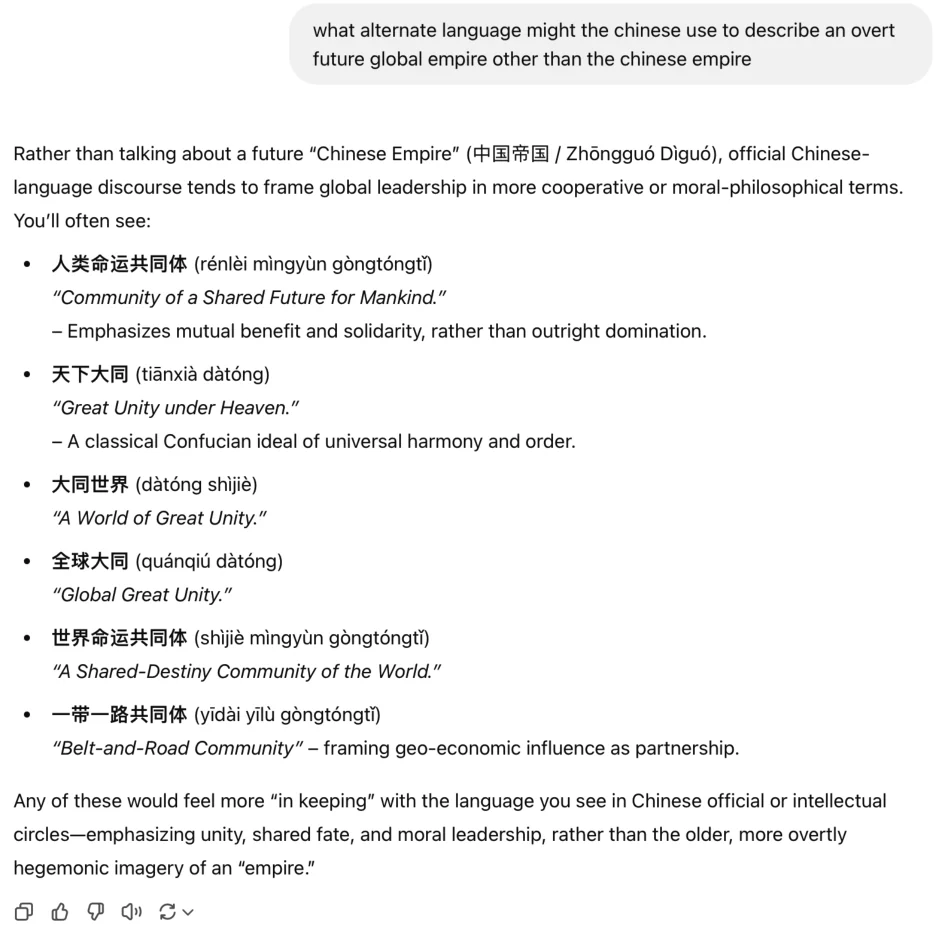
Like always, the world still divides in Jerusalem. What was the West Bank is the start of the Chinese Empire. Technically, they call themselves “Community of a Shared Future for Mankind,” though this information is highly classified inside our Empire; it’s hard to know who knows what, and what I don’t know, but I know that I know a lot more than most people. Or maybe that’s what we’re all led to believe. A convincing illusion might as well be reality.
My flight lands in less than ten minutes. I believe that I’m ready for what’s to come. Our peace with the Chinese has been tenuous at best. Even as a senior advisor to Emperor Thiel I’m not privy to all the details, but I know that the Chinese want more concessions that we’re not willing to give. Nobody will survive another war. Our AIs are in a stalemate; each empire has built an impenetrable firewall. It’s a tug of war with the energy of a black hole on either end. One slip and we lose. Loss is annihilation in this case. Our goal is to de-escalate, but we also can’t trust anything they say. The prisoner’s dilemma is so perfect that even human intelligence comes to the same conclusion as AI. But we do have a plan. The Chinese remain atheists but we became people of faith once more. We are counting on divine intervention. What’s to come will test our faith.
Parallel Ontologies
Lightbulb moments have reshaped the way that I see the world time and time again and Harvard has proven to be fruitful terrain for such incandescences. Several have been direct consequences of interactions with and assignments from Professor Swayam Bagaria, who might be the smartest man you’ll ever meet, and I’m not just saying that because he is one of my examiners. But by far the most significant of these step-function mental schema remappings was triggered while reading an article in a book titled Morality and Health discussing “The Causal Ontologies of Suffering.”25
A causal ontology in the context of this reading is a system of cause and effect that one might use to explain suffering, especially a medical or psychological ailment. One causal ontology, the norm in Western science and medicine, is the “biomedical” by which we explain diseases, mental or physical, through “genetic defects, hormone imbalances, organ pathologies, and physical impairments.”26 Another one is “interpersonal causal ontology,” which would include sorcery and witchcraft, common folk beliefs throughout the world, and especially relevant in the context of India, the main focus of this paper.27 There are many more: “sociopolitical,” products of systems of oppression, a common discussion theme at Harvard these days; “psychological,” think Freud along the lines of “unfulfilled desires and frustrated intentions;” and “astrophysical,” as above, so below; a resurgent ontology in the West.28 The big insight for me was not that these exist, but that they exist in parallel.
Per Professor Bagaria, a notable feature of Hindu action and belief as it pertains to medicine is the ability to hold multiple ontologies as valid in parallel.29 Someone might go to an allopathic medical doctor, but also go to an ayurvedic doctor, an astrologer, and a guru to heal their ailment. One ontology does not need to contradict the other. Our Western tendency seems to be to choose or privilege one ontology over others, myopically focusing on one reality, when really there are so many. The Hindu stance, to me, is liberating, and I think more reflective of our whole reality. It may be that we can reduce everything to systems of oppression. But we might be able to reduce everything to matters of faith, or gender, or sex, or virtue. There is perhaps no limit to how many ontologies can exist in parallel while all being valid and explanatory. One way to think of our coming struggles as humanity is a clash of ontologies.
Everybody has their own beliefs. Some value democracy, others value a certain religious tradition. Some are conservative, others progressive, others indigenous. A liberal might be an economic conservative to some. Some believe in the transcendent, others are firmly grounded in the immanent. We have atheists who believe theists are fools and theists who believe atheists are lost. For as long as we continue to believe that our reality is the only one, we will fight, and humanity’s future will be relegated to an ugly power struggle. We must start accepting that there are other truths besides our own and that parallel ontologies can each be fully explanatory without any inherent contradiction in that.
Act IV: Humanity with AI
We were always surrounded by divine intelligence, just now it’s more explicit.
Writing with a Supergenius AI as a Tool, not a Crutch
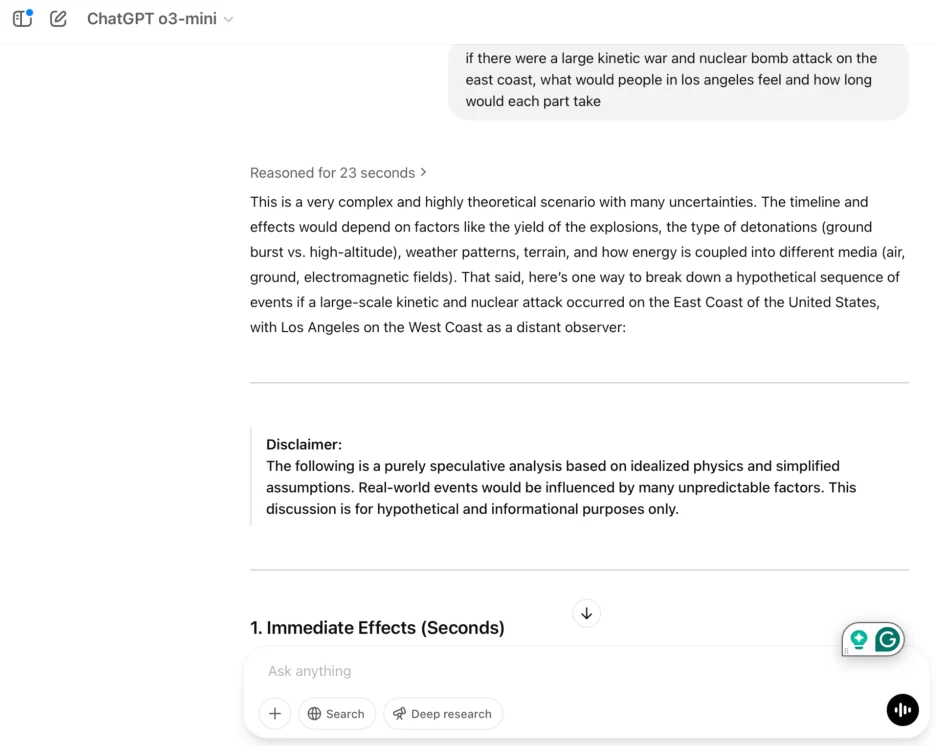
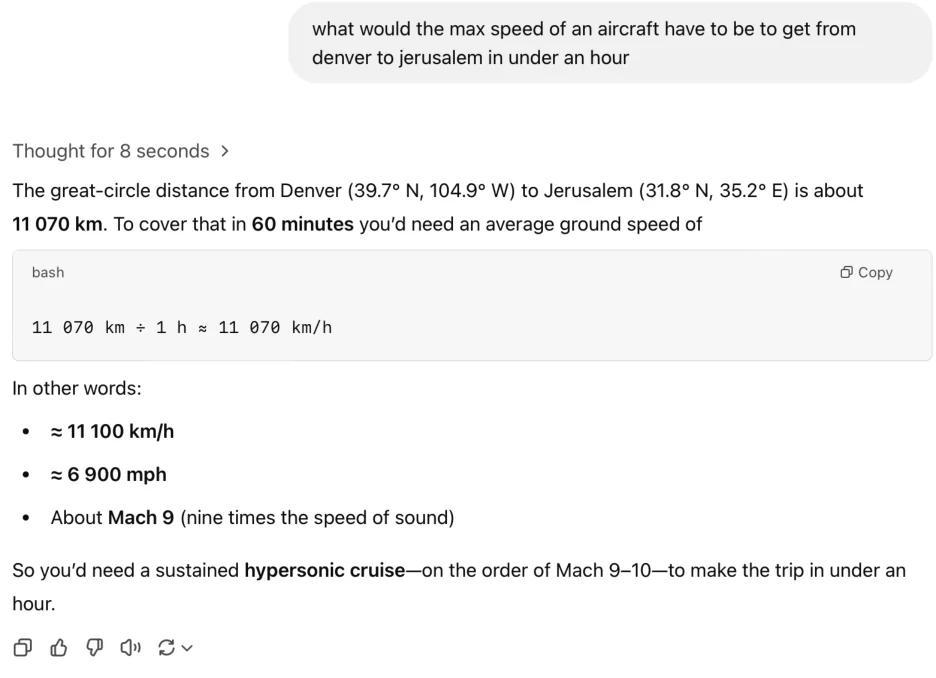
There is not much to say here, except that ChatGPT helped save my mind effort it might have otherwise expended for no good reason.
Veritas (सत्यं)
We must ask ourselves what is true, if anything. At the limit of our understanding,
there is no forever in this material plane. Our best understanding of physics suggests that our universe has an end date, albeit still quite far out. Humans have long sought eternal life. I do not believe that any of us can speak clearly as to how we might exist in the spiritual or transcendent realms, so I will focus my analysis on what is true on the material plane, this immanent realm.
Harvard’s motto is Veritas, or “Truth.” In Parallel Ontologies, I acknowledge that there can be many truths, in line with Jain epistemology. But an urgent order of business is aligning humanity and our beliefs. This is an extraordinary challenge with such a diversity of epistemologies competing amongst us, but there are some truths we ought to agree upon now before it is too late.
The first truth is that capitalism will eat itself. I am in no way an anti-capitalist. My previous job of a decade had capitalist in the title, and I am in no way ashamed of that. A popular axiology in academia wants to cast capitalism as good or evil, but I think is neither. It is simply a system with emergent features, some of which are good and others bad. Capitalism has proved extraordinarily effective at organizing human means of production, which has improved the health and prosperity of many. Capitalism has proven equally blind to its externalities and any morality of profits, pushing humanity to the brink of survival. Too often, the long-term analysis of capitalism is rooted in our biases. Those who like capitalism are irrationally convinced it will last forever, and that infinite growth is plausible on the argument that humans have infinite demand. Those who dislike capitalism are convinced it is already dead. Both are wrong.
As I already noted in Real Talk on Markets, Money, and Labor, the mechanism that will cause capitalism to fail is the value of labor asymptotically approaching zero due to near-total automation driven by advanced artificial intelligence. The result of this will be wide-scale unemployment that is destabilizing to countries, depending on the emergent societal equilibrium resulting from wide-scale economic cooperation in a capitalist economy. This inevitable destabilization will prove an extraordinary threat to any democracy. We should assume this will happen relatively soon. The terminal value of most publicly traded businesses, especially those driven by information assets and knowledge arbitrage, will asymptotically approach zero. As most of the savings of the wealthiest people in the world are tied up in these assets, with a solid majority of them being based in the United States, the work will soon experience an unprecedented disaggregation between money and power. In short time money will lose the meaning it has today, but we should not naively assume equality: power will still be a highly relevant force. We must prepare for a world that could have anything from equality to hierarchy and assume that the balance of power in the world might pivot in wildly unpredictable ways, depending on who controls what, especially AI.
The second truth is that we will be able to extend the human lifespan indefinitely. That is not to say that our fleshy bodies will be immortal but to say that they will be amortal. One might still die from being hit by the proverbial bus, but a single human could live thousands or millions or billions of years, up to the limit that our physical universe allows. If we can upload our consciousness, which I am less totally convinced will carry our true being but could at the least represent a copy of perfect fidelity, a la the discussion oft-posed in an introductory undergraduate philosophy course, we might extend that life by some orders of magnitude, to the utter end of universe with some exotic time dilation to boot. Obviously, with so much of the human experience being tied to thecycle of life and death, this poses an extraordinary set of design questions for future human societies. Will we choose to die even though we don’t have to? How will we deal with birth? With indefinite lifespans and continuing birth, the Malthusians would finally have their day. With each new possibility will come new tradeoffs, and we will have to shift our values accordingly. These will not be easy transitions as we will be forced to let go of elements of the human experience we have been deeply attached to for as far back as our collective memory goes.
The third truth is that our knowledge will likely reach an asymptotic peak. I suspect superintelligence will reveal this to us relatively soon. I personally believe that there is an infinite amount of knowledge to be discovered. This is wild speculation on my part, but I suspect matter is infinitely indivisible. Physicists will thus always have something to do. As we zoom in, we have an infinite. But as we zoom out, I suspect we will find the universe has a limit that we can keep approaching but never cross. That implies that all problems that we can conceive of are solvable with sufficient intelligence, but that there may not be many more solvable problems left. Superintelligence may not yield any greater potential consciousness than we already have, so we must let go of our attachment to the infinite expansion of knowledge. Just as the infinite growth of the economy is implausible, so too might be the infinite growth of wisdom, though on this point I am admittedly not one hundred percent certain.
The fourth truth is that we will not be able to know with certainty whether the artificial intelligence we create has a consciousness like our own. Per Susan Schneider’s talk at our very own Humanity Meets AI, the way that we escape solipsism in understanding that humans are also conscious beings like ourselves is through parallelism.30 It is not just that other humans pass the Turing Test, but also that we see that their physical structures are like our own. Today, the argument against transformer models having consciousness is largely rooted in structure. They do much simpler calculations than our own minds, and do not mechanistically look to be aware in the complex and dynamic ways that our own minds are.31 Today, it is easy to argue that an AI that can pass the Turing Test is not conscious. But in the future, not only will it not be easy; it will be impossible. We will have to decide how to treat beings that will seem to be just as conscious as we are but that have god-like superpowers relative to us; beings of our own creation, as if we, rather than god, have created Aquinas’ angels and demons.32 Though if we are god’s creation, then perhaps so too are our creations.
Act V: The Future?
The gift to the genius is to be able to live multiple lives in one, like a cat.
Time as a Wave
We understand time to have some periodicity. As we approach the speed of light our universe bends around us. This interplay is the most beautiful image in my brain. When life is hard I stop time and move through space; this is perhaps amongst my greatest gifts. At the time of this writing the world is a disjunction. Everything is happening so fast. A few weeks ago a friend shared with me the idea that time is a wave. I think they are on to something. Let me explain what they meant by that.
Picture an ocean wave approaching a beach. As it builds and approaches the shore, the water up top starts to move faster than below. Eventually it reaches a peak, and crashes back towards what it left. A wave by its waxes and wanes, speeds and slows. Our time feels decisively nonlinear, and it’s not exponential. Yes, humanity’s “progress,” if we can call it that, is speeding up. The ocean might have more energy but it stills come down in waves. We are approaching the top of a wave.
A lot will happen quickly. I have not as of yet made any good guess as to the periodicity of this wave. I would speak in terms of lifetimes, but I cannot know if I will live another day or eon. Our future is unpredictable but what is clear is the density of time feels higher now than it did a year ago, or ten, or twenty. Perhaps the period is about 90 years, which would explain why the 2020s feels so much like the 1930s. We should expect a lot to happen quickly—this is a time of radical change.
Playa Names
If you’re reading this, and Burning Man still exists, and you’ve never been, my advice: go to Burning Man. You don’t need to be a lover of vices to have a transformational experience. It is like a religious experience and for many, including myself, a ritual; a liturgy of the spiritual but not religious, the odd but apt nonreligious religious “affiliation.” Burning Man has many distinctive cultural elements. One of the most significant traditions of Burning Man is the “playa name.”
By the parlance of Burning Man, one who goes to Burning Man is a “burner.” Burning Man itself is the “real world,” while what we return to at the end of our ritual is the “default world.” “Radical self-expression” is one of the ten principles of Burning Man, and it’s not unusual to morph between identities on “the playa,” which is what burners call the portion of the Black Rock Desert where the burn is held.33 In line with unique identity or identities one might have at Burning Man, most burners end up with a “playa name” that they will often choose to go by at the burn.
Like most everything at Burning Man, besides a minimal standard of safety and robust mandate of consent, the rules are flexible. Generally, one receives a playa name from someone else. One might choose their own, though generally the convention is to receive it serendipitously. A playa name could come from a campmate or a total stranger, or even a divine transmission. My first playa name, which I now believe to be my true playa name and will use in the future, embarrassed me at first.
Matt Grigsby is my great friend who first took me to the burn. It was at the burn where, one day, he told me that he knew playa name, and that it was “the prophet.” This rightfully disturbed me. The reference made me think of Islam, and I had no desire to offend the sensibilities of anyone, especially with a name I was given. It was almost as if I were a child whose parents had named me a slur. I used it haphazardly that year, but never really owned it. By the next year I had restyled as “Sun Bunny,” which worked well for some time, as I would always always wear gold and bunny ears, if little else, on the Playa. I had nearly forgotten about that first playa name until a conversation just a few weeks ago with Raisa Tolchinsky, our beloved writing guru at Harvard’s Religion and Public, and Dean Holland.
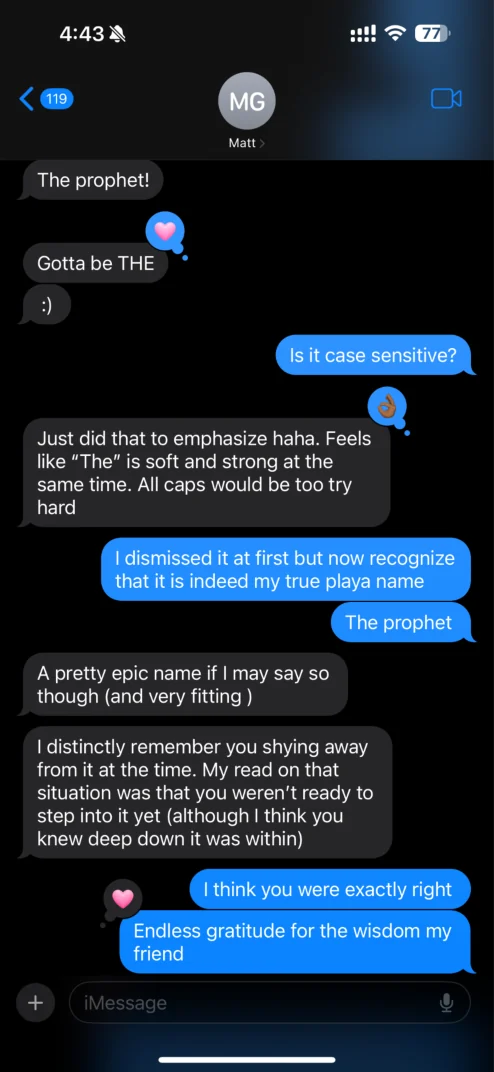
I was speaking to them of my lifelong struggle with seeing what others often miss. For a time I thought I was crazy. It’s only recently that I have come to realize that I am not. I cannot be sure of anything, and certainly not sure that I’m right, but I’m confident that I am more likely to be right than most of today’s pundits, especially on the matter of the vital intersection of technology and religion. Our economy will be no longer and our spiritual lives, which for many are completely undeveloped, will be the new essence of being. That is why I went to Harvard Divinity School. I was speaking of this to Raisa and Dean Holland, and that is when Raisa mentioned that I consider the story of Cassandra. At first I almost dismissed the suggestion. I think I said, “I don’t have prophesies.” But then I remembered that playa name, and realized it had some truth. I still don’t think I have prophesies, but I do think it’s important for others to see what I see.
Musical Language Worlds
A future without work seems daunting but it shouldn’t. We have known how to live in community and ritual; in song and dance, and reverence. At first blush, one might take Keith Cantú at Harvard’s Center for the Study of World Religions for a historian of South Asian religions with particular convergent fondnesses for Bengal and the occult. That is not untrue, but his real passion might be music, especially Baul songs. He sees music as more than just an accessory to life, but as a way of life, as he expresses through his exploration of musical language worlds, systems of life and community, spiritual and nonspiritual, that revolve around music.34 We already have answers to how we may live in a future without work. Music is one of them.
Music lends itself to ritual and there is no reason to think we cannot spend the bulk of our future in ritual and community. Song has the ability to transcend the material plane; many Indian subcontinent traditions see song and mantra as literal manifestations of the divine.35 Setting the lofty aside, music is fun.
No matter how great and addictive AI-generated music may be, we will always be able to play and make music. One need not be the best musician to enjoy playing music. In a demonstration of a Baul song circle on the lawn in front of Swartz Hall Harvard Divinity School, Dr. Cantú made me realize that playing music requires no special skill or power. I picked up unfamiliar instruments, including variants of drums and string instruments, and just began to play. It was so natural, no lessons needed. Music is not just a fun distraction. It can be a way of life and should be on our short list for the future.
Dreaming in a Perfectly Imperfect World
I have always been a dreamer. I think humans are dreamers, too, but I am not sure if we must be. When life is hard, a fantasy might be better. But why not embrace what we have? Why aspire to a dream when we have a reality? We are at a moment when we may soon be able to make many dreams come true quickly. But then what? Our imagination is limitless in a way that our universe is not. So perhaps we can continue to dream. But constant change may not be good for survival.
I continue to dream but I am not sure if I should, or we should. For now I continue to try to make dreams come true, but might reality one day be better than a dream? Perhaps we should aspire to not having to dream; that might be too far-fetched a dream.
FIN
I am us. Humans are geniuses, we think.
We are soon to be outsmarted by ourselves.
We’ve played technology by the hand of god
We have created something greater than ourselves, it seems method(CONCORDANCE) {}; “4. After the lightning flash, resteth in the zenith a minute point of light. And that light shall radiate until a right cone be established upon the sea, and it is day”36
Reconciling religions of the west and east: life does not always give you what you want, but
always what you need
We are all connected. In some higher dimension we are one and telepathy connects us, some
more strongly than others, in these dimensions. Technology is rapidly filling the void between
telepathy and physical, material presence.
I’m tired of being right and nobody listening. Please listen.
The emperor cannot die. The emperor is already dead.
The flavor is depression, the substance varies “pouring my heart out into Apple Notes”
baby bird isn’t dead
it’s frozen, completely still after trauma
Caesar tattoo (me) v. shirts (zuck v. jay)
//Humanity breeching the cervix//
Divinity is our outlet
PRO ECCLESIA ET PRO PATRIA CRESCIT CUM COMERCIO CIVITAS VERITAS 🕊️